
3 min read
Building the confidence to procure a mission-critical dispatch system
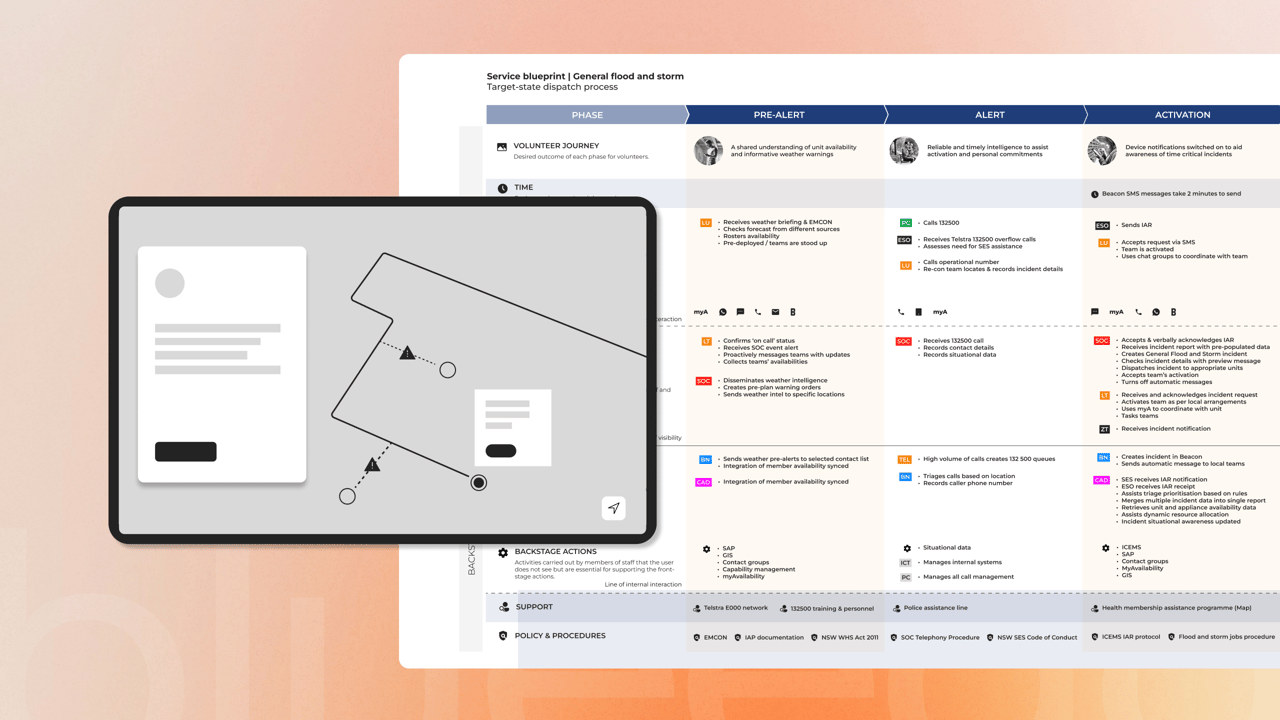
Blueegg partnered with NSW State Emergency Service (NSW SES) to build the evidence base for a mission-critical technology decision. We delivered validated current-state journey maps of how dispatch works today, translating them into target-state service blueprints for how it should work in future, and turning both into procurement-ready recommendations.NSW SES could now guide its technology investment and align stakeholders with confidence, reducing uncertainty ahead of Computer-Aided Dispatch (CAD) procurement and implementation.
CONTEXT
Better emergency response starts with better operational understanding
NSW SES coordinates emergency responses to floods, storms and tsunamis across New South Wales through a workforce of staff and thousands of volunteers. As incidents become larger and more complex, responders rely on accurate information and coordinated decision-making to mobilise people and resources quickly.
Following the 2022 NSW Flood Inquiry, the organisation recognised the need to strengthen the systems supporting operational response. One priority was establishing a Computer Aided Dispatch capability that could improve visibility, coordination and decision-making during emergencies. Before investing, NSW SES needed to understand exactly what that system should enable.
PROBLEM
Scaling emergency response required more than paper and whiteboards
NSW SES relies on thousands of volunteers to respond to emergencies across New South Wales. Coordinating people, vehicles and equipment during major incidents demands accurate information and clear operational visibility.
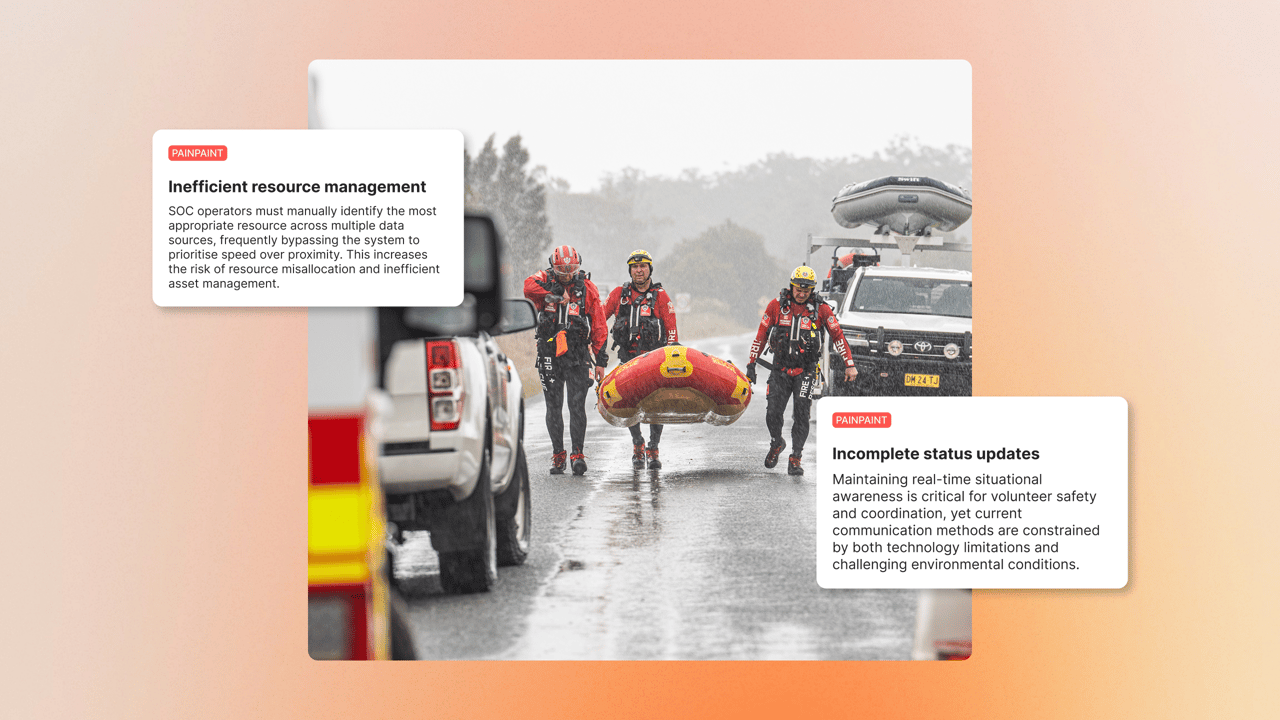
Many dispatch activities were still supported by paper records, whiteboards and physical peg boards. While these methods had evolved over time and served local operations, they made it increasingly difficult to coordinate large numbers of resources, maintain situational awareness and scale responses during complex emergencies.
As NSW SES looked to introduce its first Computer Aided Dispatch capability, it needed to understand how work was really being done before defining how it should be supported in the future.
APPROACH
Alignment through volunteer journeys
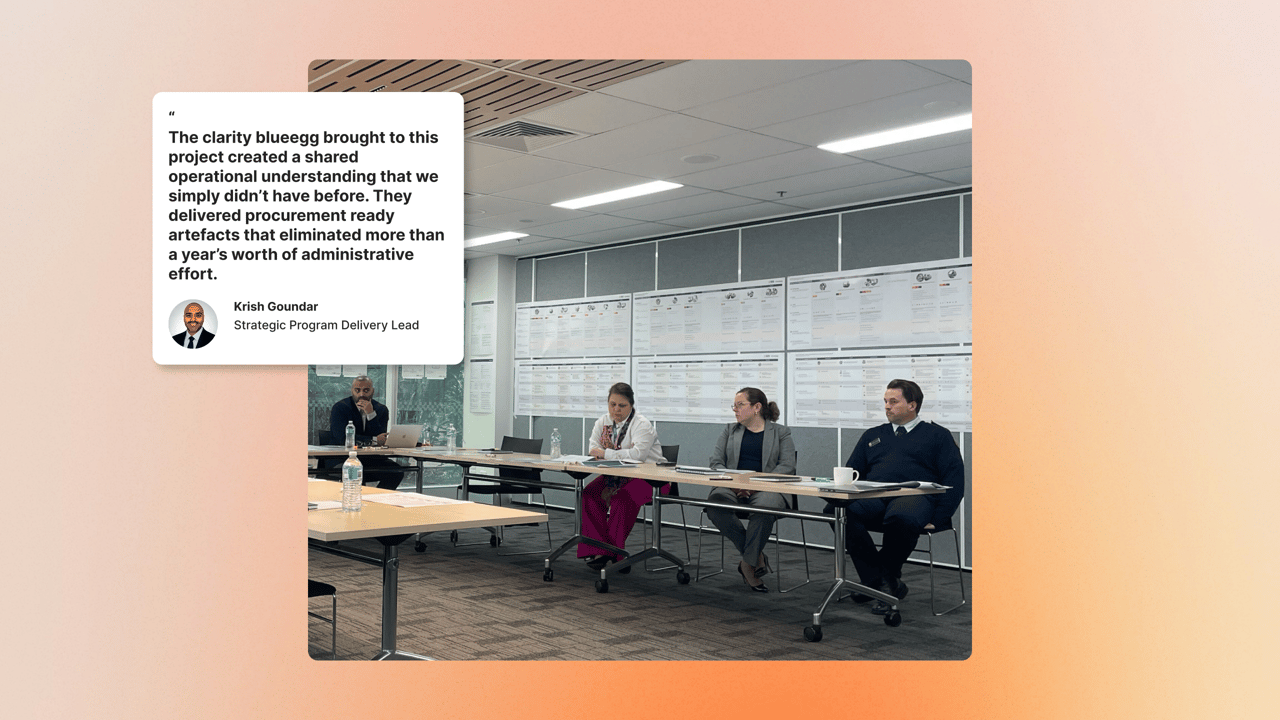
Across 20 workshops and consultations, we worked with 59 participants, including operational leaders, ICT specialists, emergency management teams and volunteers. Together, we mapped six emergency response scenarios, capturing how incidents flowed through the organisation, where manual processes created friction and how decisions were made under pressure.
This process created a shared view of a complex operating model that had previously existed as local knowledge spread across individuals and teams. That alignment became the foundation for defining a target-state operating model and the capabilities required of NSW SES’s future Computer Aided Dispatch system.
INSIGHT
Faster, informed decision making depends on real-time situational awareness
Mapping emergency response end to end revealed that when assigning resources, dispatchers were constantly piecing together information from multiple sources to understand who was available, where they were and whether they had the right capabilities for the job.
That gap in timely, connected information, more than any shortage of experience, is what slows decisions down. A single, real-time view of incidents and resources became central to designing the future operating model.
FEATURE
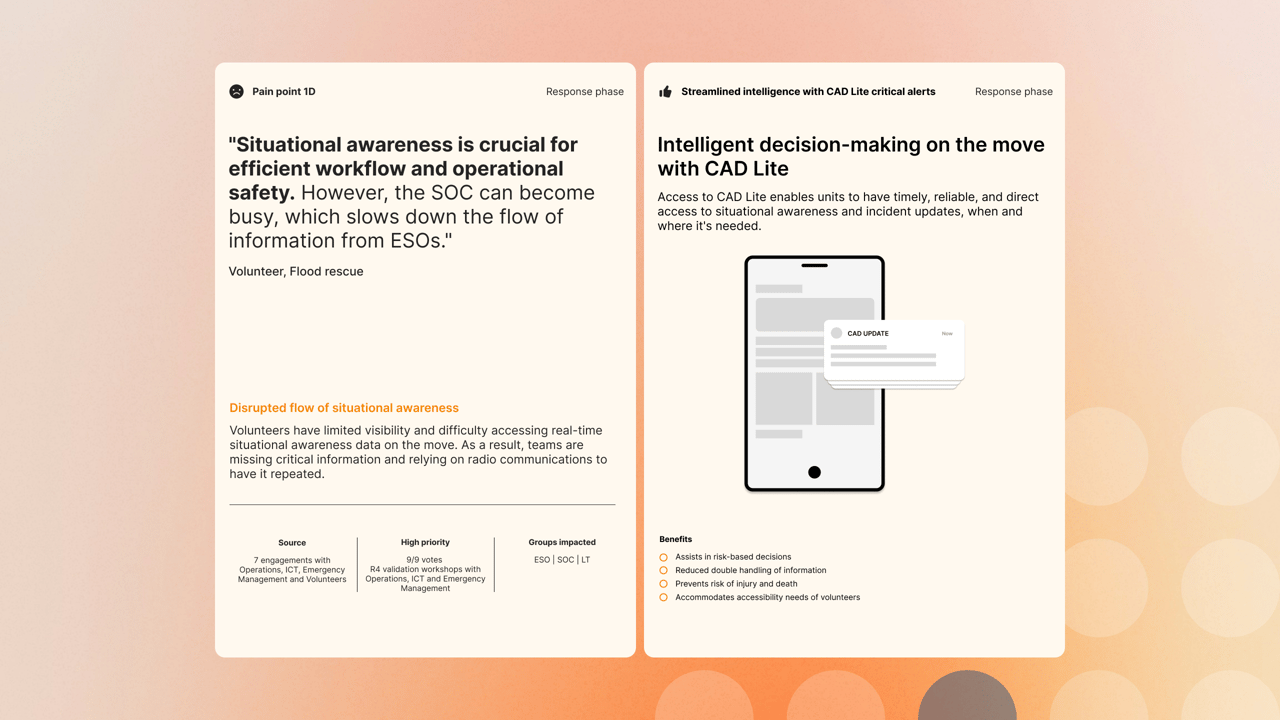
Real-time data efficiently allocates the quickest and most capable resources
Asset management streamlines deployment, giving operators visibility of resource capabilities, enabling better coordination and dynamic tasking during time-critical incidents
Benefits
- Reduces emergency response times
- Efficient resource allocation
- Assists risk-based decisions
OUTCOME
A blueprint for emergency response when every second counts
The project gave NSW SES a shared understanding of how emergency dispatch operates today and a clear vision for how it should operate in the future.
Rather than procuring technology based on assumptions, the organisation entered the market with validated operational journeys, prioritised pain points and evidence-based capability requirements. The recommendations informed NSW SES’s subsequent Request for Information (RFI), providing a strong foundation for the procurement of its first Computer-Aided Dispatch capability.
duke
3 min read
Building the confidence to procure a mission-critical dispatch system
Blueegg partnered with NSW State Emergency Service (NSW SES) to build the evidence base for a mission-critical technology decision. We delivered validated current-state journey maps of how dispatch works today, translating them into target-state service blueprints for how it should work in future, and turning both into procurement-ready recommendations.NSW SES could now guide its technology investment and align stakeholders with confidence, reducing uncertainty ahead of Computer-Aided Dispatch (CAD) procurement and implementation.
CONTEXT
Better emergency response starts with better operational understanding
NSW SES coordinates emergency responses to floods, storms and tsunamis across New South Wales through a workforce of staff and thousands of volunteers. As incidents become larger and more complex, responders rely on accurate information and coordinated decision-making to mobilise people and resources quickly.
Following the 2022 NSW Flood Inquiry, the organisation recognised the need to strengthen the systems supporting operational response. One priority was establishing a Computer Aided Dispatch capability that could improve visibility, coordination and decision-making during emergencies. Before investing, NSW SES needed to understand exactly what that system should enable.
PROBLEM
Scaling emergency response required more than paper and whiteboards
NSW SES relies on thousands of volunteers to respond to emergencies across New South Wales. Coordinating people, vehicles and equipment during major incidents demands accurate information and clear operational visibility.
Many dispatch activities were still supported by paper records, whiteboards and physical peg boards. While these methods had evolved over time and served local operations, they made it increasingly difficult to coordinate large numbers of resources, maintain situational awareness and scale responses during complex emergencies.
As NSW SES looked to introduce its first Computer Aided Dispatch capability, it needed to understand how work was really being done before defining how it should be supported in the future.
APPROACH
Alignment through volunteer journeys
Across 20 workshops and consultations, we worked with 59 participants, including operational leaders, ICT specialists, emergency management teams and volunteers. Together, we mapped six emergency response scenarios, capturing how incidents flowed through the organisation, where manual processes created friction and how decisions were made under pressure.
This process created a shared view of a complex operating model that had previously existed as local knowledge spread across individuals and teams. That alignment became the foundation for defining a target-state operating model and the capabilities required of NSW SES’s future Computer Aided Dispatch system.
INSIGHT
Faster, informed decision making depends on real-time situational awareness
Mapping emergency response end to end revealed that when assigning resources, dispatchers were constantly piecing together information from multiple sources to understand who was available, where they were and whether they had the right capabilities for the job.
That gap in timely, connected information, more than any shortage of experience, is what slows decisions down. A single, real-time view of incidents and resources became central to designing the future operating model.
FEATURE
Real-time data efficiently allocates the quickest and most capable resources
Asset management streamlines deployment, giving operators visibility of resource capabilities, enabling better coordination and dynamic tasking during time-critical incidents
Benefits
- Reduces emergency response times
- Efficient resource allocation
- Assists risk-based decisions
OUTCOME
A blueprint for emergency response when every second counts
The project gave NSW SES a shared understanding of how emergency dispatch operates today and a clear vision for how it should operate in the future.
Rather than procuring technology based on assumptions, the organisation entered the market with validated operational journeys, prioritised pain points and evidence-based capability requirements. The recommendations informed NSW SES’s subsequent Request for Information (RFI), providing a strong foundation for the procurement of its first Computer-Aided Dispatch capability.